The Realities of Transition Mode


The Grim Realities of Transition Mode


Summary of a recent experience relating to Transition Mode.


I have been quite vocal of my hatred of Transition Mode (for WPA3).


We have a solution for this - dual SSIDs:  https://wifisecuritywizard.com/general/problems-with-wpa3/


IMHO - Transition Mode is dumb! Turn on WPA3, and for everything that doesn’t support it, create a second SSID for now... while you upgrade everything!


I have actually said “it’s 2025 for goodness sake, how many devices do you have that don’t do WPA3?!”


Well, the other day, the universe decided to mess with me...


I arrive on site, I upgrade the system, 5GHz only WPA3, everything is working great!


I do one last check, and one of the users mentions, “Oh, the Brother color laser printer isn’t working.” (It’s a nice little device. Prints really well. Cheap to run.)
 

Pesky Printer

 Oh, of course, I’d changed the SSID name and password!


H’mmm... it doesn’t see the Wi-Fi SSID (obviously I have enabled 5 GHz only, since it’s 2025).


I enabled 2.4GHz to see if that was the problem, and it was. Oh... so the Brother printer only supports 2.4??? I’m disappointed!


Ok... well, let’s connect it then…


Brother asks me to enter the WEP key, “I am sorry? What, now? WEP key?”


To cut a long story short, I eventually realize the Brother printer doesn’t understand WPA3. (Obviously, I have enabled WPA3 only, since it’s 2025).


So, I turn on WPA2 Transition Mode, and... Bingo! It works again!


I am not one to be disillusioned easily, so I think “Let’s just plug this into ethernet” Oops! No ethernet port!
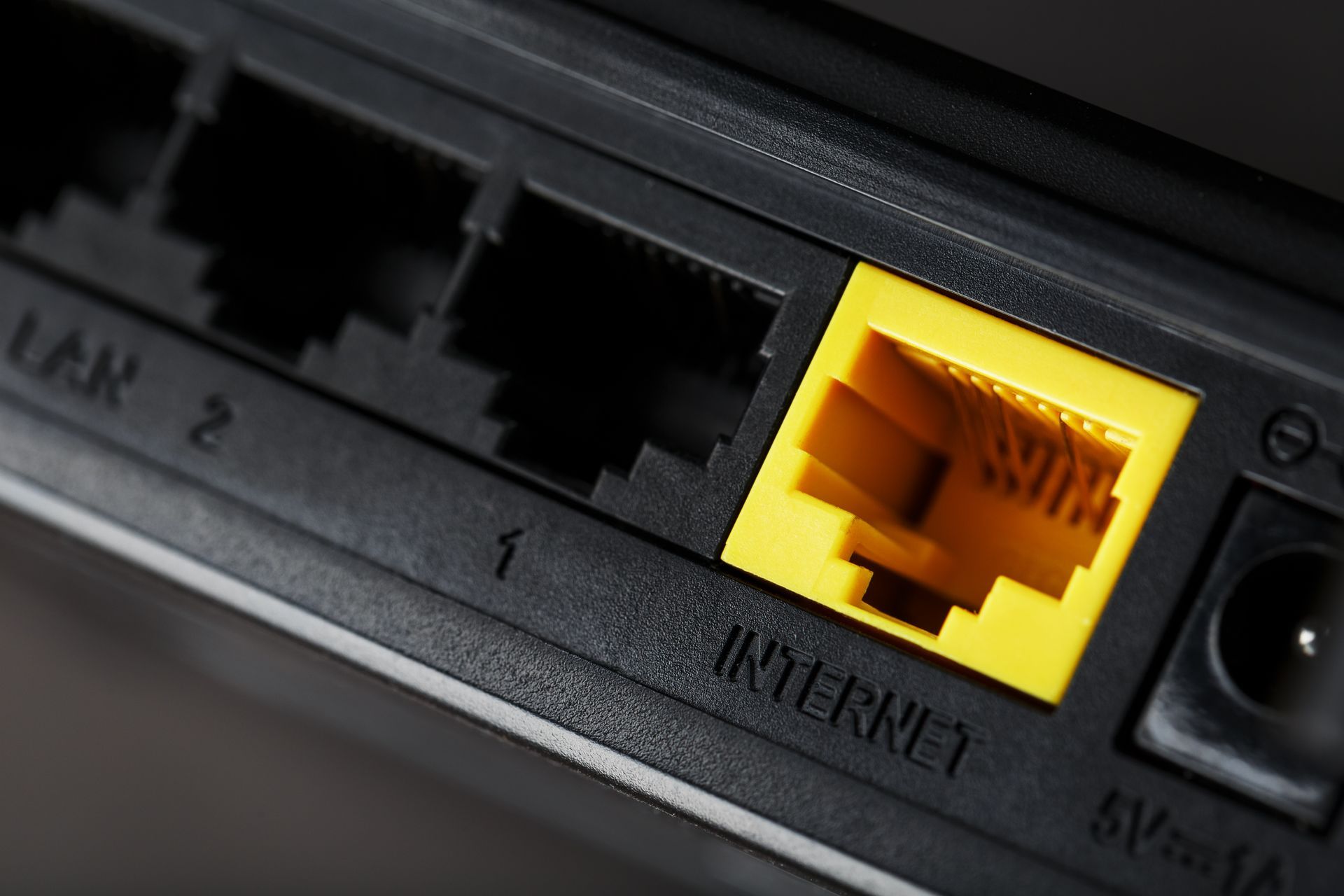

I remember after we’d bought the printer were installing it, we found it had no ethernet port! (It was a good-priced laser printer that they needed in the office. We had just experienced some irritating issues with an HP Laser Jet, and decided to try Brother for the first time – since they were cheaper.)


So, I am stood there (in 2025, remember), with a printer that’s only 3 or so years old, that won’t do WPA3, and doesn’t have a 5GHz capable radio! (Sigh)


Now to be fair to Brother, I never tried to upgrade the firmware, but now I am really disappointed!!! No Transition Mode for us. I create a second SSID, 2.4GHz only, nice secure long password, and we are done. Turn Transition Mode back off on the original SSID (I really do hate it)!


Next job: searching for a new laser printer for the remote office. Back to HP it is!!!

My advice: make sure your printer supports WPA3 - it'll save you many headaches!!


Published with permission. Original post here: https://wifisecuritywizard.com/uncategorized/the-realities-of-transition-mode/ 


===

#General #Security #TransitionMode # WiFi #WPA3

===

About NC-Expert

NC-Expert is a privately-held California corporation and is well established within the Wireless, Security, and Collaboration industry certification training, courseware development, and consulting markets.

Led by its Founder and CEO, Rie Vainstein, NC-Expert has won numerous private contracts with Fortune level companies around the world. These customers have depended on NC-Expert to train, advise, and mentor their staff.

So, remember, if you are looking for the best IT training just call us at (855) 941-2121 or contact us

NC-Expert Blog
By Rie Morgan August 20, 2026
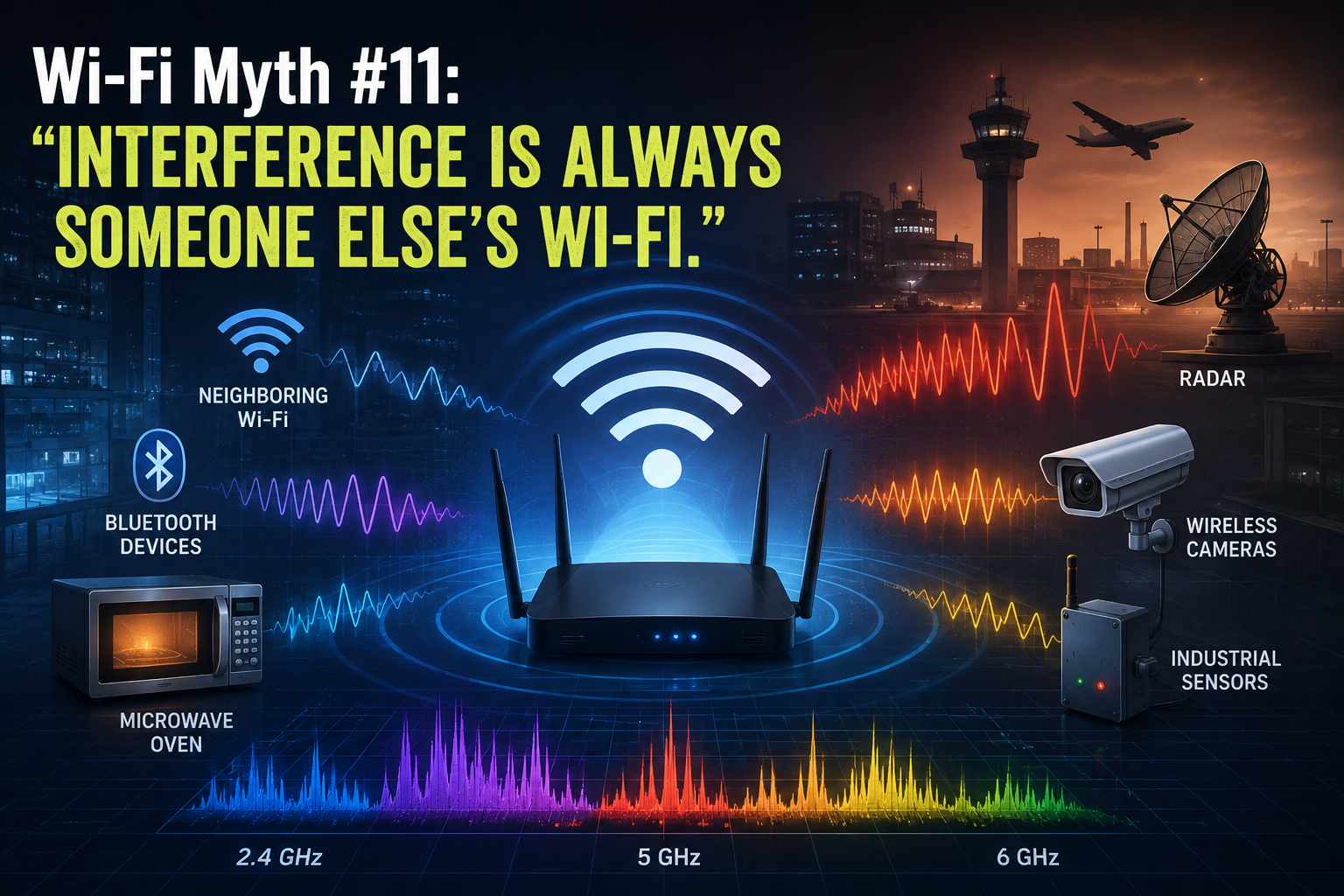
When Wi-Fi performance suddenly deteriorates, interference is often the first culprit to be suspected and, when this (interference) enters the conversation, attention tends to turn immediately toward neighboring Wi-Fi networks. “Someone must have installed another AP.” “The office next door is probably using our channel.” “There are too many SSIDs around here.” Sometimes, this diagnosis is exactly right, but RF interference has a much larger cast of characters than just neighboring APs. In fact, some of the most frustrating wireless problems occur when the interfering device isn’t speaking 802.11 at all! The spectrum doesn’t particularly care whether the energy occupying it came from an enterprise AP, a Bluetooth headset, a microwave oven, or something considerably stranger. To a Wi-Fi radio trying to communicate, unwanted RF energy is simply unwanted RF energy. Wi-Fi Has to Share the Neighborhood The 2.4 GHz band has always been something of an RF “community center”. Wi-Fi operates alongside Bluetooth, Zigbee and other technologies, while various consumer, industrial, medical, and electronic devices may also generate energy within or around the same spectrum. Microwave ovens are perhaps the most famous example. Their emissions can interfere with 2.4 GHz Wi-Fi, particularly when clients are operating nearby. Bluetooth devices, cordless equipment, wireless cameras, sensors, and other transmitters can also contribute RF energy. Some interferers transmit continuously. Others appear periodically. Some hop frequencies. Others produce wideband noise. That last category can be particularly entertaining to troubleshoot... in the very specific sense of “entertaining” that wireless engineers use when they have been staring at spectrum analysis for three hours! The important point is that interference doesn’t need to understand Wi-Fi to disrupt it.
By Rie Morgan August 13, 2026
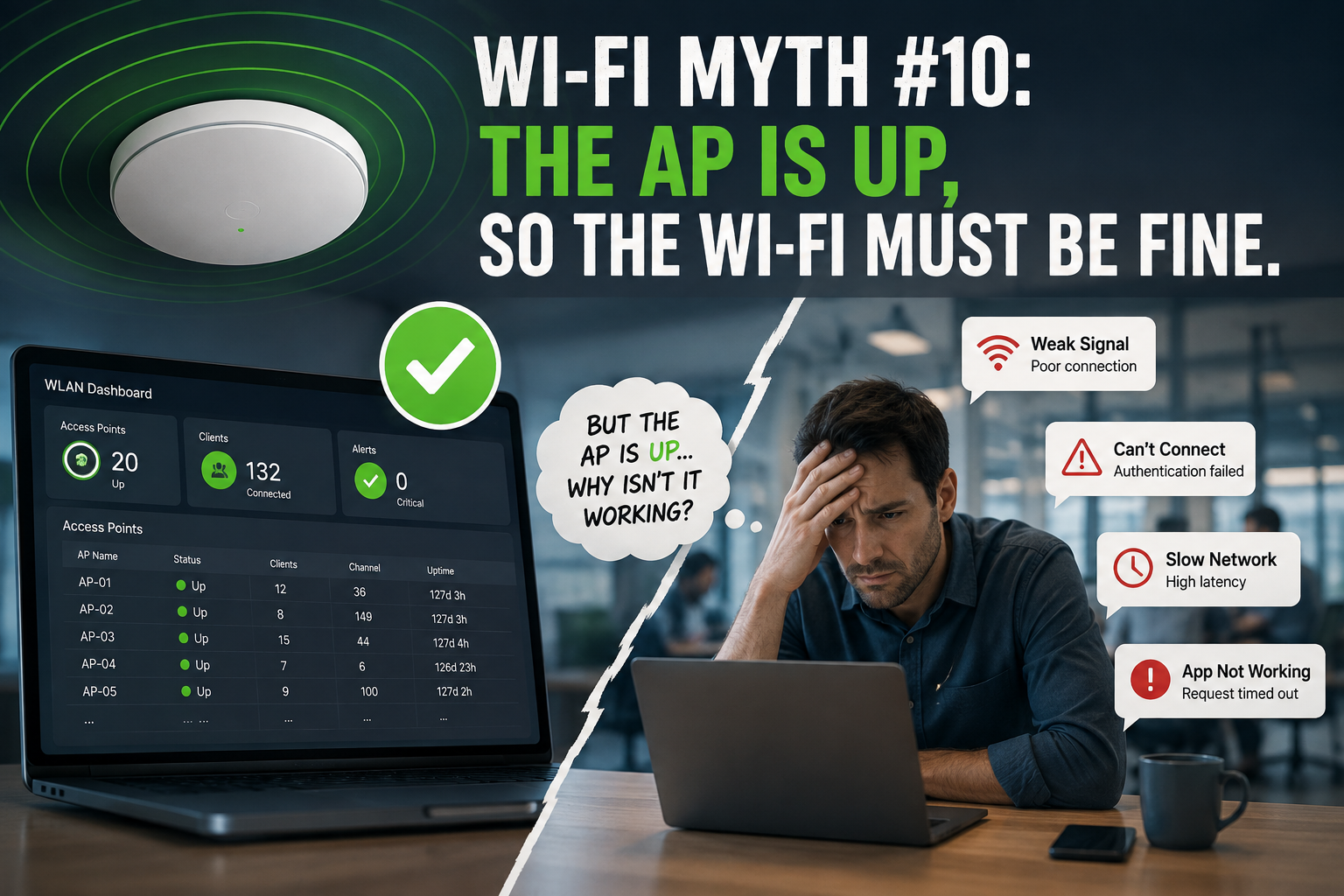
There is something wonderfully reassuring about seeing a row of green APs on a wireless dashboard: APs connected; radios operational; no obvious alarms; everything green. Excellent! The Wi-Fi must be fine... Except, of course, the users are complaining that Teams calls are breaking up, handheld scanners keep disconnecting, authentication takes forever, and someone in Accounting has discovered that turning Wi-Fi off and back on again temporarily fixes everything. Welcome to one of the more persistent myths in enterprise wireless: if the AP is up, the Wi-Fi must be working. An operational AP tells us something useful... but it tells us surprisingly little about the experience of the clients actually using the network. “Up” is an Infrastructure State When a monitoring platform reports that an AP is up, it usually means the infrastructure can communicate with it. It tells us: - the AP has power - its Ethernet connection is functioning - it may have established its management or CAPWAP connection - its radios are probably operational - it hasn't disappeared into the networking equivalent of a “black hole” ...all good things. But none of those things proves that a client can successfully use an application. Consider what still has to happen after the AP proudly announces its existence. A client must: discover the WLAN associate authenticate obtain the appropriate network configuration reach its default gateway resolve DNS access the required network resources, and maintain sufficient RF performance to exchange data reliably. Depending on the environment, that journey may involve: 802.1X RADIUS DHCP DNS VLANs ACLs firewalls roaming mechanisms upstream switching WAN connectivity cloud services ...and several other systems waiting for their opportunity to make your afternoon more “interesting”. ;-) The AP actually being operational is merely one part of that chain!
By Rie Morgan August 6, 2026
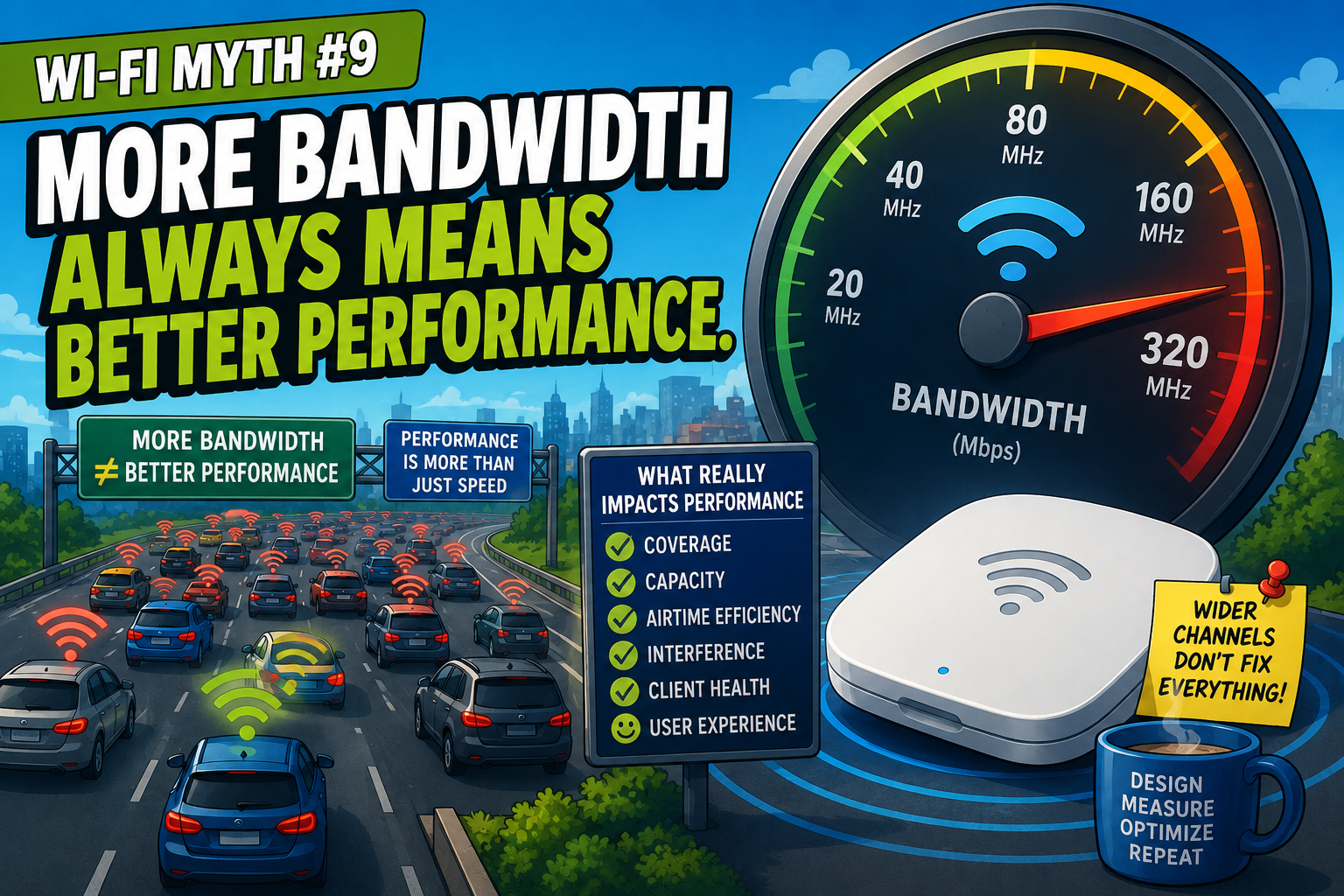
If there's one thing network users love, it's bandwidth. Need faster Wi-Fi? More bandwidth. Application running slowly? More bandwidth. Video buffering? More bandwidth. Someone sneezed near the wireless network? Probably needs more bandwidth. :) As Wi-Fi engineers, we've all heard it. Somewhere along the way, bandwidth became synonymous with performance. But while bandwidth certainly matters, it's only one ingredient in a much larger recipe. In many deployments, increasing available bandwidth produces little improvement and, in some cases, it can actually make things worse! Like many Wi-Fi myths, this one contains just enough truth to be convincing. Let's bust it...